|
Purpose and Justification
1. What concrete, documented generator commitments justify creating the Central South Hub? Please provide for each: project name, precise location, development stage, status of grid connection, and firm financial commitments.
2. If no generators are currently committed to connect to the Central South Hub, what is the rationale for continuing with the transmission routing work?
3. Is EnergyCo constructing transmission capacity to satisfy existing generator obligations or to attract new projects? Cite the specific policy, directive or mandate that authorises this approach.
Stranded‑Asset Risk and Financial Prudence
4. How does EnergyCo ensure compliance with Treasury and government fiscal sustainability rules to avoid creating stranded or redundant transmission assets?
5. Please supply reference to any independent cost–benefit or economic analyses, or any analysis at all, showing that the net benefits of the Central South Hub and associated 500 kV build justify the construction cost. Demonstrate why this is the preferred route using this analysis.
6. If the Central South Hub is under‑utilised or never used, who is legally and financially liable for the write‑down or ongoing costs: NSW taxpayers, or electricity consumers?
REZ Plan Changes and Consultation Integrity
7. The New England REZ was originally reported as 8 GW of generation capacity; the public documents now reference 8 GW of network capacity. (This is dignificant because 8GW of network capacity equates to approx 18GW of intermittent generation capacity). Why was this definition changed without public consultation? Were you unaware of the intermittent nature of renewable energy, or was this intentianal trickery to more than double the capacity of the REZ?
8. Under what legislation or regulation may a REZ target be altered without re‑opening formal consultation? Please identify the legal basis.
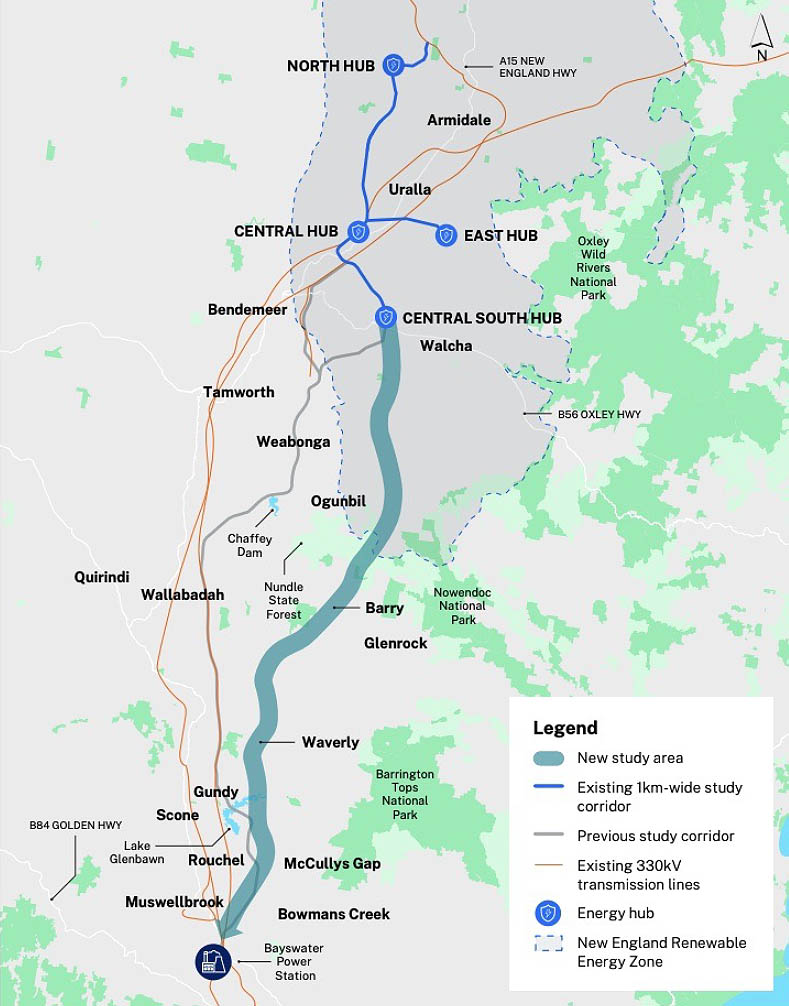
9. Why was the Bayswater–Walcha transmission alignment amended without prior notification to affected landholders or Walcha Council before the public release?
Central South Hub Function and Downsizing
10. EnergyCo has described the Central South Hub as having “reduced capacity” and being “scaled to generator demand.” Does that statement confirm there are presently no committed generators for the hub?
11. If the hub’s capacity is being reduced, what is the justification for retaining the originally planned transmission route and scale?
12. What modelling or scenario analysis supports keeping the hub’s land footprint when its proposed role has shifted from a major switching station to a local consolidation point?
Environmental and Agricultural Impact
13. The NSW Government committed to avoiding REZ infrastructure on high‑value agricultural land. Which specific land‑classification or agricultural value mapping layer did EnergyCo use to assess Walcha land, and how was it applied?
14. What is the justification for routing dual 500 kV circuits through identified high‑value grazing country when alternate, already‑cleared corridors exist?
Governance, Transparency and Evidence
15. Will EnergyCo publish the full generator interest register, the independent economic justification, and the updated route comparison assessment prior to lodgement of any Environmental Impact Statement?
16. Given changes to hub function, route and assumptions about generator interest, will EnergyCo prepare and publish a new Scoping Report or fresh development application reflecting those changes?
Community Bottom Line
17. If there are no firm projects committed to connect to the Central South Hub, why should construction proceed? In plain terms: no committed projects = no hub = no transmission — do you accept that proposition and why or why not?
|