Nothing much to see here. Rumours are that this project has in recent times, lost support from many of the orginal hosts.
Still waiting to see the scoping sears report.
DEVELOPER
TURBINES
MEGAWATTS
Skye Ridge is a project located west of the Walcha township, aiming to build 140 turbines, with a nameplate capacity of 840 MW. This was a concept drawn up by Walcha Energy, and offloaded to Origin in February 2024. At this stage, there was no scoping report submitted, no real detail of the project. It was little more than an idea.
Origin have shown no indication of genuine interest to progress the project since the reality of poor location, biodiversity risk, and fading landholder support have been made abundantly clear to the new owners of the project. Deadlines for the Scoping Report have been promised “next quarter” since the middle of 2022 – and are now not even spoken about, as newsletters, and other forms of communication, have largely disappeared.
This could be a broader economic reality with wind developments, as much as any local issues.
Prior to taking ownership of the concept of Ruby Hills Wind, and renaming it Skye Ridge, Origin had purchased a going concern in the south of the state – Yanco Delta Wind. This is a 1500MW project, on the open plains near Hay NSW, that had progressed through Scoping, EIS and had been granted consent for construction. It has very little opposition (Two objections in total!! ). The project has negligible biodiversity risk of damage, laying on the open plains, in arid, low rainfall land. The project has easy access on flat land providing an ideal construction site, it is approved by NSW Planning, and ready to go. Yet STILL, Origin recently announced that it will delay financial commitment for at least 18 months. That is certainly a bad omen for a project like Skye Ridge.
The economic viability of wind generation was poor 5 years ago, it has only become more expensive, while solar and battery has become cheaper.

The only project recognised by EnergyCo as being a generator that will connect to the Central South Hub, 15km west of Walcha, is Skye Ridge Wind. Without this project, there is zero justification for the Central South Hub.
Energy Co are having a hard time justifying the Central South Hub, and the massive transmission build to connect it to Bayswaqter.
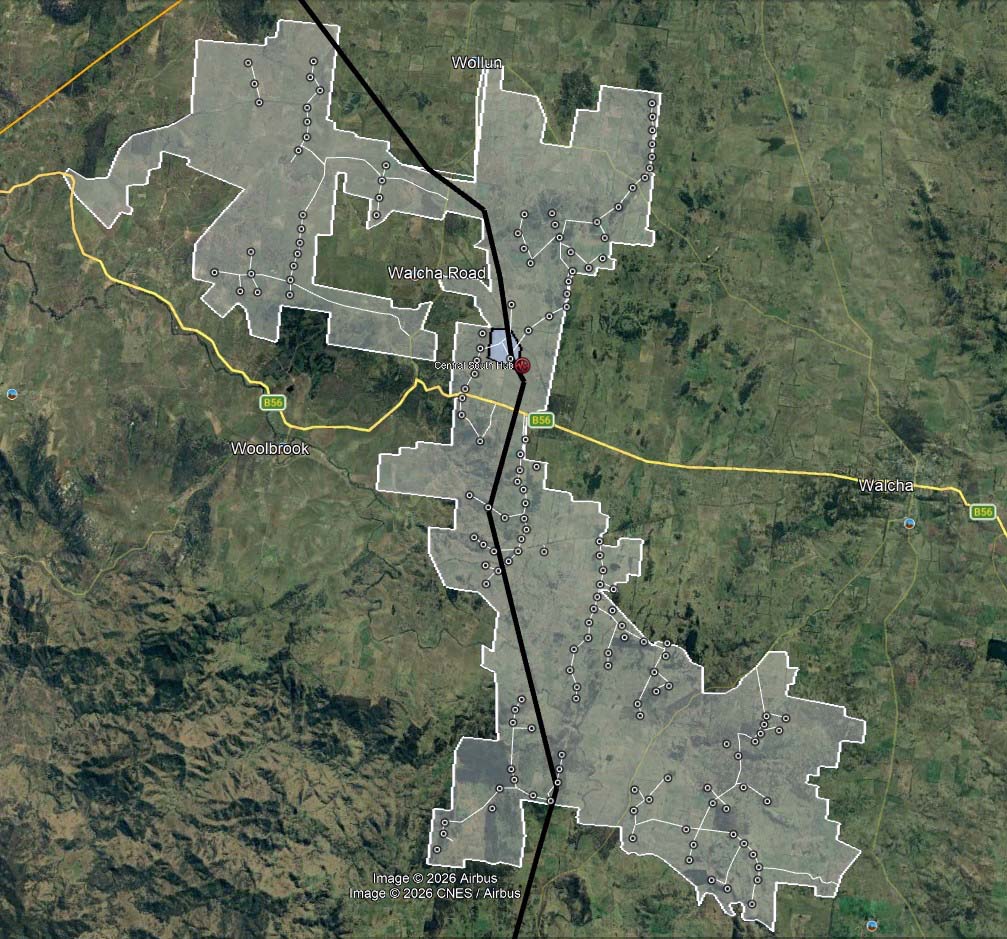
Having not submitted a scoping report for the project by the owners, either Walcha Energy or Origin Energy, information is thin on the ground. The details are most likely very different to the information provided in May 2023, when this project layout was proposed, at an information event for the project. Origin Energy gained control of the project in February 2023.
As a land owner ( the lessor), it is ultimately your choice what you agree to and sign in relation to Wind Turbine developments that may impact your property.
A) You will be presented with a large set of documents prepared by a tier one legal firm engaged by the Developer (lessee) and documents will be biased and in favour of the developer. The documents will likely include a preliminary Development Agreement setting out the details of the site, proposed commercial returns, rights of entry for all sorts of purposes including surveying, ecological reviews, wind velocity monitoring etc. They may offer you a small sum for “independent review” however it is likely that a thorough review would lead to extensive negotiations and a large legal bill to do so.
B) The documents will likely provide further agreements including the Lease itself. You may be required to consent to a caveat on your title. This immediately means that ANY transaction involving the Title of your property is subject to the consent of the developer. It could mean that the whole of your title that is bound up in the Development Agreement (even if only a small corner of your property is impacted) will be subject to that caveat. Further you may be asked by the developer to agree to a caveat from a third party such as the developer’s financier or equity partner. Who knows who you may be dealing with.
C) The Lease Agreement will become operational upon completion and commissioning of the Wind Turbines. The Lease will be for a term of around 25 to 30 years and will have an option, exercisable by the developer, for a further 25 to 30 years. You may wait many years before the Development is completed.
D) It is likely that the lease will contain a recision clause in favour of the developer whereby the Lease can be rescinded at short notice (probably 3 months) with NO FURTHER OBLIGATIONS TO PAY YOU RENTAL. If you are relying on this income for retirement or to pay out inter generational family members, remember that there is a risk that the income stream can disappear.You will need to rely on the “make good” provisions in the Lease whatever they are and how enforceable they may be against the owner of the assets at the time.
The above items are just a few that we think will be included in Developer documentation and, in the absence of access to the Documents, it is impossible to tell what other Clauses may be included.
In general Turbine and Solar Farm developers seek to have access to the state power grid and to negotiate the pre-sale of power generated under an Long Term Energy Service Agreements (LTESA) that provides certainty of future pricing. In turn, the Developer will then use these agreements to raise capital (Equity and Debt) against the future income stream provided by the LTESA contracts. These contracts may be a much lower price than the spot price of energy however provide the Developer with a clear pathway to profitability.
The less the developer pays you as land rent and the higher the negotiated price through the LTESA route, the higher the profit margin and in turn the higher the return on equity employed.
You as the land owner are not likely to receive an adequate return unless you collaborate with your neighbours BEFORE agreeing to any proposed deal with a developer.
The Documents used by Wind and Solar developers are complex, thorough and will be drawn up strongly in favour of the Developer. Given the very long term nature of these agreements, it is in your interests to seek independent legal advice.
If you wish to discuss the above in confidence please reach out to us.
DEVELOPER
Origin
TURBINES
140
(in 2022)
MEGAWATTS
860
SUBMISSION COUNTDOWN